WR: Mysteries of the Organism : Testament to the Life and Teachings of Wilhelm Reich
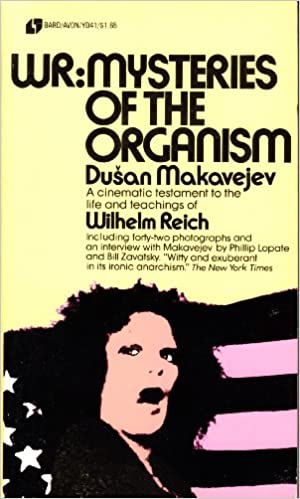
W.R.: Mysteries of the Organism, a 1971 film by Serbian director Dušan Makavejev, is a cinematic homage to the work of psychologist Wilhelm Reich,...
Also Available in:
- Amazon
- Audible
- Barnes & Noble
- AbeBooks
- Kobo
More Details
W.R.: Mysteries of the Organism, a 1971 film by Serbian director Dušan Makavejev, is a cinematic homage to the work of psychologist Wilhelm Reich, matched with a story about a Yugoslavian girl's affair with a Russian skater. Sexual repression, social systems and the Reich's orgone theory are explored. The film's narrative structure is unconventional, intermixing fictional and documentary elements.
After initial screenings, both in and out of Yugoslavia, W.R. was banned in that country for the next 16 years. Makavejev was subsequently indicted there on criminal charges of "derision" towards "the state, its agencies, and representatives" after he made intemperate remarks to a West German newspaper about the ban. His exile from his home country lasted until the end of the regime.
____
Plot:
The film intercuts documentary footage and clips from other films — notably the Stalinist propaganda film The Vow (1946) — with an imaginative and satirical narrative about a highly political Yugoslav woman who seduces a visiting Soviet celebrity ice skater. Despite different settings, characters and time periods, the different elements produce a single story of human sexuality and revolution through montage.
The woman, Milena, violates her proletarian convictions (and rejects the sexual advances of a worker) by pursuing a Joseph Stalin-like celebrity ice skater — Vladimir Ilyich (Lenin's first name and patronymic) — who represents both class oppression and corruption from the West into communist beliefs. She succeeds, with difficulty, in sexual consummation, but V.I. is unable to reconcile his inner conflicts and ends the encounter by decapitating her. Distraught, V.I. sings a Russian song after the murder: "François Villon's Prayer" by Bulat Okudzhava.
____
Poet and performance artist Tuli Kupferberg of the band The Fugs, dressed as a soldier, parodies war and the sexual nature of human fascination with guns by stalking affluent New Yorkers on the street and masturbating his toy rifle. The scene is set to The Fugs' 1965 song "Kill for Peace". As part of the film's climax, the gun masturbation imagery is intercut with other orgasmic sequences. This segment highlights Reich's ideas that sexual frustration and violence are connected.
____
Artist Betty Dodson discusses her experiences in drawing acts of masturbation, as well as her discussions within consciousness raising groups about female sexual response. The Dodson sequences are relatively straightforward documentary interviews; Dodson's large scale drawing of a man masturbating dominates the background of the shots. This segment illustrates a freer attitude toward sexuality.
____
New York artist Nancy Godfrey was among a loose group called Plaster Casters, who were known for taking plaster casts of rock stars penises. In a meeting with Jim Buckley, co-founder-editor of the porn magazine Screw, Godfrey makes a plaster cast of Buckley's erect penis as a documentary part of the film. The soundtrack features another song by The Fugs, "I'm Gonna Kill Myself Over Your Dead Body", with Tuli Kupferberg satirically mimicking John Wayne in his a cappella vocals.
_____
Jackie Curtis, a cross-dressing member of Andy Warhol's entourage and star in his films, is shown on the streets of New York enjoying an ice cream cone with a partner. Curtis' appearance highlighted Reich's theories of gender and sexuality.
____
The film features a rare on-screen interview with neo-Reichian therapist Alexander Lowen, the founder of bioenergetic analysis, during a therapy session, including scream treatment.
____
Reich's daughter Eva (1924–2008) appears on camera, speaking about her father's work and the sickness of contemporary life.
____
The film includes re-stagings of scenes from Sergei Eisenstein films, alluding to the montage era of film making in the Soviet Union.
___
Shots of the incinerator in which Reich's books were burned in New York City are also included in the movie.
- Format:Mass Market Paperback
- Pages: pages
- Publication:
- Publisher:
- Edition:
- Language:eng
- ISBN10:
- ISBN13:
- kindle Asin:B0DLT5T494
About Author